
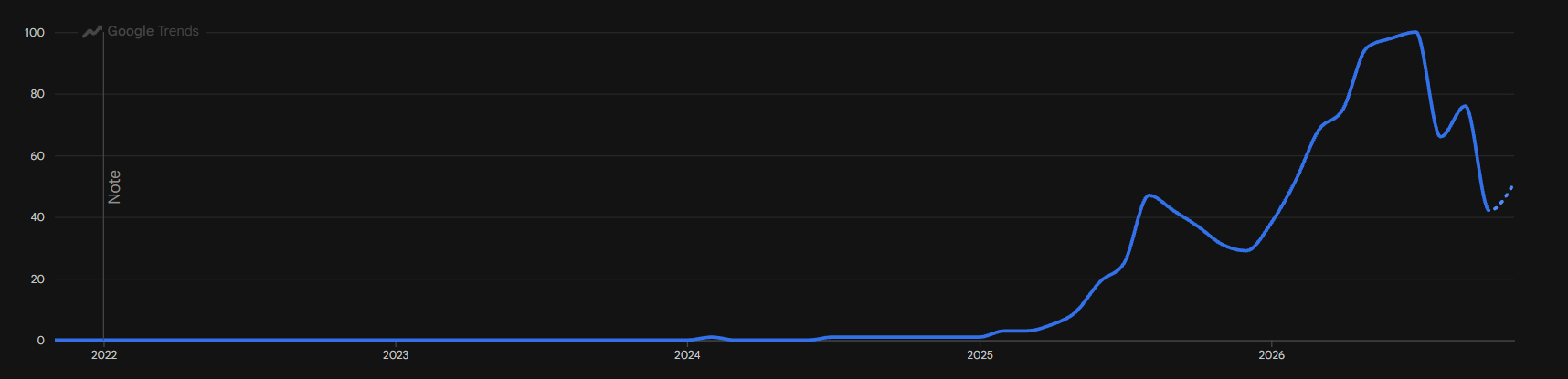
The word “Generative Engine Optimisation” (Generative Engine Optimization for the Americans) is a relatively recent fab. The term was first coined in November 2023 in a research paper (more on that below). By 2024 it was spreading into its niche and by 2026 it became mainstream and google acknowledged it as an official SEO strategy.
What is GEO?
GEO was first used as “Generative Engine Optimization” back in 2023 and then was later published at KDD 2024. Published by a team of researchers at Princeton University and IIT Delhi, they defined it as "a flexible black-box optimization framework for optimizing web content visibility for proprietary and closed-source generative engines". Put plainly, tweaking a page’s style and content to make it more citable by AI Tools. Their findings showed that adding citations or quotations and stats could boost a page’s visibility in answers by about 40%. Since this publication use of the word has skyrocketed, but understanding has not.
Is SEO replaced by GEO?
Back in May of 2026 NielsenIQ released data finding that, for US consumers:
- 42% of consumers have used at least one AI tool to shop within the past month
- 17% have used AI for product recommendations
- 10% have used a voice assistant to purchase and/or reorder items
- 19% use a subscribe or auto-replenish feature for repeat purchases
- 10% have engaged with an AI-powered shopping assistant
- 5% have used fully autonomous AI agents to place orders on their behalf
And that number is only going to rise.
One website owner even told me SEO is dead. Its all about GEO now.
They are wrong. Yes, GEO is new and a popular buzzword and actually has some unique distinctions, but SEO is not dead. Mainly, because GEO is only one step in how an AI acquires data. The first step, like always is Search Engines. AI Agents have realised that what their AI learnt is hallucination prone, and so most Ais have a search tool they are firmly guided to use.
Perplexity is yet to give me an answer without crawling at least 20 pages.
My point here being that if you aren’t ranked for your keyword on google, then the chance of GPTBot, ClaudeBot or ByteDance’s bot picking up your site is minimal. The human factor matters and traditional search engines are still the backbone of how LLMs acquire information.
LLMS.txt and other AI specific items
It never hurts to have them. This page is so not standard, that the Finance Sector Project I was working on received 56.4k unique visitors this month. Of these only 1 chose to access llms.txt, ironically, it was not a bot, but rather a curious human. llms-full.txt is yet to have someone acknowledge its existence. Google has stated that AI Overviews still rely on traditional SEO signals, so far ignoring llms.txt entirely and this goes for every major AI provider. It’s not a standard, it’s not reliable and, to an AI, it isn’t really much easier to crawl. Instead it is another way people with a disdain for AI can confuse it or mislead it.
Check it yourself
To demonstrate how Search Engines are still as important as they’ve ever been I am going to search up a singular question on google and record the first 15 results (first 2 pages excluding sponsored results with deduplication in both dataset and results) and compare what % of citations from AI were on one of those sites. To make it a fair test I am using a new browser with personalisation off from a neutral IP. Now, my results will be regional to the UK and not quite consistent across the globe.
I used the phrase “How many pieces of fruit do Scientists say I should eat per day?”
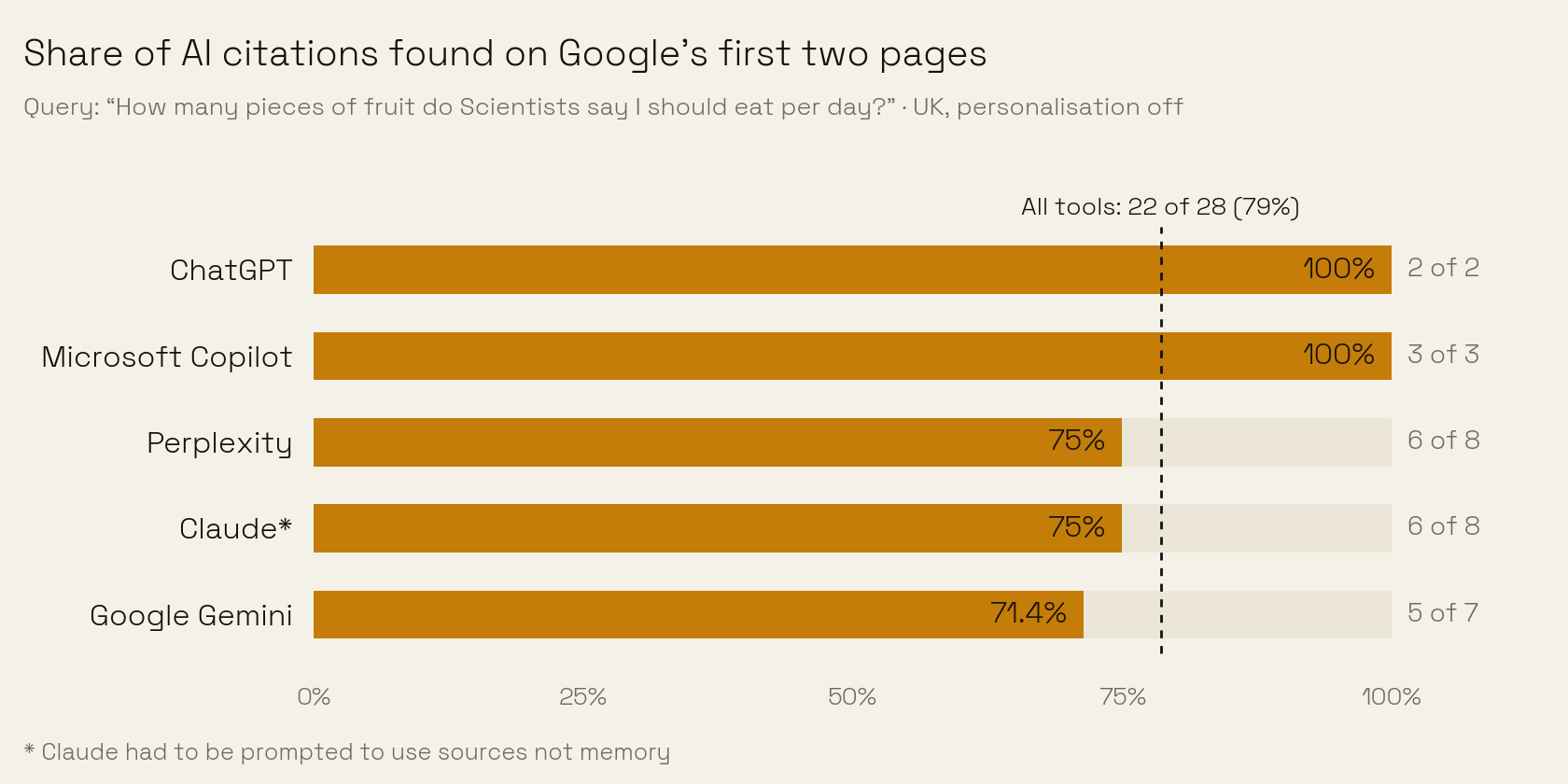
This produced a noticeable overlap, additionally, the differences in citations may be linked to regional customisation and underlying Search Engine choice. Google gave me results clearly targeted to the UK, while Claude used sources without considering my location.
So, is SEO dead?
Not even close. 22 of the 28 sources cited by the AI tools I tested (about 79%) were already on Google's first two pages. AI doesn't replace search. AI uses Search. If you want to show up in AI answers, start by showing up on Google or other Search Engines. Good GEO relies on good SEO.